Friday, 3 February 2023

Social Entrepreneurship and Civic Innovation Training


Social Entrepreneurship and Civic Innovation Training

Course Description/Background

Our society is facing urgent challenges - from poverty to the impact of climate emergencies, environmental damage, unemployment and social inequality. Addressing them has not only become very urgent, but has created a huge demand for a generation of leaders who can tackle these national and global challenges. Requisite disciplines for a career in the sector are no more limited to just humanities and social science majors, individuals with background in pure sciences, arts, management sciences, engineering, medicine and other backgrounds - are all seeking occupation in the field thus making it a major career destination points.

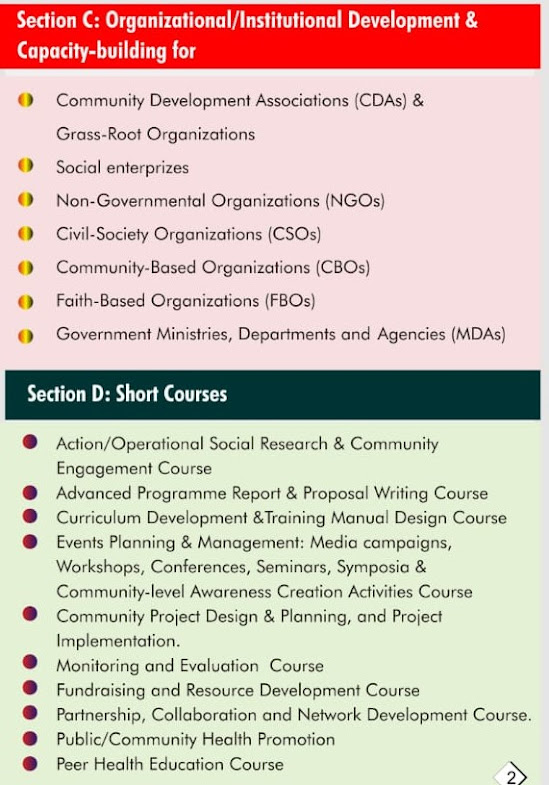
Many new social organizations are created leading to more opportunities in Non-Governmental Organizations (NGOs), social enterprises, Faith-Based Organizations (FBOs), charities, Civil-Society Organizations (CSOs), Community-Based Organizations (CBOs), corporate bodies, Government Ministries, Department and Agencies (MDAs), multi-national corporations, local and international development agencies.

Training Goal

For individuals desiring to pursue a career in the sector, our training are designed specifically to help build the practical skills that are needed every day by social entrepreneurs. Apart from learning about innovation processes, participants acquire the managerial and leadership skills to run their own business ventures. Training cover topics such as starting a social enterprise, scaling, replication, social entrepreneurship business planning, approaches to solving societal problems and moving an existing charity towards a social enterprise model.

Course Duration: Two weeks.

Time: 9:00 am – 5:00 pm daily

Mode of Training: Face-To-Face or Online

Venue: Abuja Office, CDI Nigeria, Office Complex, Suite B, Block 1, Beside GT Bank, University of Abuja Teaching Hospital Road, Gwagwalada, FCT – Abuja.

Course fee:  N120, 000 this includes the registration fee, cost of the training and course materials.

Payments to Account Name: Community Development Institute in Nigeria, Bank: GT BANK, Account Number: 0173357636

Contact us on Telephone 08165807273 or send an Email to info@cdinigeria.org, or visit us @www.cdinigeria.org


Sunday, 18 December 2022

Undergrads can Begin to Create Financially Rewarding Businesses


Take the leap and start your own business.

The Undergraduate Social Innovation Fellowship Programme (USIFP) is an initiative that promotes the culture of social entrepreneurship —a transformative process of using new ideas to create businesses that solves societal problems. It encourages the use of innovation to drive job creation and employment among youths in the nation’s higher institutions.

The social sector is a huge, untapped market for youth career and employment. Through the fellowship programme, students starts early to develop key competences and skills that allow them to leverage on the social value of their disciplines to create businesses that will help them to earn and avoid unemployment when they graduate.

The fellowship programme therefore challenge students to constantly come up with innovative breakthrough solutions to societal problems by adopting community-centered approach to their disciplines while utilizing theoretical frameworks that are practically useful for applied efforts to enhance the well-being of communities. Through this way, academic disciplines can practically benefit communities and even drive development by helping to solve some of the society’s most pressing social challenges.


Programme Philosophy

The fellowship programme was put in place against the backdrop of the rising youth/graduate unemployment in the country and the need to inspire youths to tap into the vast career, job creation and self-employment opportunities in the social sector. The fellowship programme stimulates the use of social innovation by youths to create their own business solutions. The programme therefore seeks to eradicate youth unemployment by encouraging youth/undergraduate innovation and solutions to societal problems. The focus of the fellowship programme is to empower youths as social entrepreneurs and civic innovators to create and run businesses that address societal problems, while preparing others for exciting career in the local and global development field.

Therefore, youths need skills for civic innovation and social entrepreneurship. The fellowship programme equips them with the tools to become professionals, leaders and change agents who create new economic opportunities by tapping into the social sector even as students.

Requirement: 

Fellows include post graduate and undergraduate students of various institutions of higher learning. In addition to having a high level of proficiency in spoken and written English, fellows should possess entrepreneurial spirit with a passion for improving lives and creating positive changes.  As potential innovators, fellows are encouraged to always see opportunities and resources where other people don’t, and be willing to harness those resources to create innovative solutions. They must also possess a strength-based mind-set, personal resilience and an appreciative approach that can enable them to discover hidden solutions.


Join the growing number of young civic innovators making a huge difference to people’s lives, the local community and the environment.

Visit www.cdinigeria.org to fill and submit our contact form.


Tuesday, 22 November 2022

LIST OF OUR CAREER TRAINING COURSES IN THE FIELD OF DEVELOPMENT


Call: +234 (0) 816-580-7273

E-mail: Info@cdinigeria.org

Visit: www.cdinigeria.org


Build The Skills for the 21st Century Development Career.


LIST OF CAREER TRAINING IN THE FIELD OF DEVELOPMENT.


Develop the skills and knowledge to build your employability in local and international development organizations.


Call: +234 (0) 816-580-7273

E-mail: Info@cdinigeria.org

Visit: www.cdinigeria.org

Saturday, 8 October 2022

• Develop a Professional Practice in Your Discipline with Our Social Entrepreneurship Business Course.


 As societies evolve, the needs and demands of one generation change for the next. Citizens must keep up with these changes to reflect the new realities. Over the last two decades, social entrepreneurship and civic innovation has emerged as a recognizable field in development work. As a result, creative young men and women are becoming involved in solving pressing local and global problems with innovative and practical solutions that create business opportunities

Whatever is your discipline?

Our social entrepreneurship training provides an opportunity for individuals of any discipline to develop critical skills and competencies to pioneer innovations that benefit humanity.

Participants will develop the knowledge, skills and attributes in their disciplines to create and run their own business platforms that address society’s complex and intractable problems and earn in the process or even qualify to fill any management role in any local or international development organization.


Course Background

Social Entrepreneurship and Civic Innovation Training is the Institute’s programme that promotes job creation, career and employment initiatives in the social sector. Participants are trained to become social entrepreneurs and innovators who can create new economic opportunities by starting and managing their own business platforms that address social problems facing the nation.


The training will help participants to build the necessary knowledge and skills to identify opportunities, trends and possibilities, generate ideas, proffer solutions, launch and advance their passion by creating new businesses that employ entrepreneurial principles in tackling many national and global social problems.

Course Overview

This course will focus on

·      Training participants to become social entrepreneurs and innovators

·    Empowering participants with knowledge and skills required to develop innovative solutions to societal problems and challenges

·  Developing participants’ capacity to create, start and manage their own social enterprises

Goal: The Goal of this training is:

v To promote the growth of social enterprises as key to addressing unemployment and hastening socio-economic advancement of the nation.

Who Is This Programme For?

·    The training programme target students, graduates, corps members, unemployed youths, professionals and individuals with interest in social entrepreneurship and civic innovation.

 Course Content

Basic modules/topics to be covered in the training include:

·        The  Evolution of Social Enterprise Business Model

·        The Conventional Business Concept and the Social Entrepreneurship/Social Venturing.

·        Social Enterprise Development And Job Creation

·        Social Entrepreneurs and The Power of Disruptive Innovation

·        Societal Problems as Opportunities for Civic Innovators

·        Key Elements to Designing A Successful Social Venture

·        Starting A Social Enterprise

·        Uncovering PASSION and Choosing a  CAUSE

·        Social Entrepreneurship and Sustainable Business Development

·        Value Creation in Social Entrepreneurship.

·        Programme Development for Social Organizations

·        Governance and Management Structure in a Social Organization

 Strong Faculty Mentoring

Our greatest strength is our faculty. The Institute has a team of highly skilled professionals and trainers who are committed to development education. The faculty comes from diverse background including government, development agencies, non-Governmental organizations (NGOs), and various institutions of higher learning, corporate bodies and international development organizations.  Participants will receive personalized guidance from experienced faculty members.

 Certification:

Upon successful completion of the course, participants are awarded certificate of participation based on their regular and prompt attendance of all sessions, group meetings, and their involvement in assignments and group discussions. If a participant misses a number of sessions or workshops, the Institute reserves the right to withhold certification.

 Standard Entry Requirement/Eligibility

Our primary concern is that applicants should be able to demonstrate the ability to succeed in the course. If an applicant does not have formal educational qualification of up to a diploma certificate level, the Institute will assess his/her relevant practical experience, alongside evidence of commitment and ability to succeed on the course.

 Course Structure:

The Institute conducts courses throughout the year, designed to meet the needs of different groups and individuals including those without prior academic qualification but have work-based experience.

Training Schedule:

Plan

Time Table

Fees

Duration


Regular

9am-3pm

    _

One Month. Daily

(Mondays-Fridays)


2months

(3Days/WK.   


6 Months

(Weekends

4Saturdays/M)


Fast-Track

9am-5pm

     _

Two-Weeks

(Mondays-Fridays Daily)


Executive/In-house Training


Individual Training


Online

Classes

9am -5pm


Client Time Schedule


24 hours           


   _


    _  

One-Week

(Mondays-Fridays)


Based on Course

Curriculum


@ Client’s Pace


Note * The Two-week course is exhaustive, compact and offers the benefits of our regular plan and much more.

Kindly confirm your participation with:

Community Development Institute | CDI Nigeria

Block 1, Suite B, Beside GT Bank,

University of Abuja Teaching Hospital Road,

Gwagwalada,

FCT - Abuja.

Nigeria.      


E-mail: info@cdinigeria.org

Website: www.cdinigeria.org


Or Call

Phone: +234 (0) 816-580-7273


Tuesday, 14 September 2021

Promoting Social Enterprise Education, Training and Mentoring as A Panacea to Youth Unemployment.


Youths have often cited that the desire to get a well-paying job is a major reason for attending higher institution. However, getting such jobs after graduation into any organization is not an easy task. With the dramatic expansion of higher education in recent decades, and with over 200,000 graduates of various disciplines who are discharged annually from the mandatory National Youth Service Corps (NYSC), the labour market has become more competitive than ever. Statistics indicate that less than ten percent of these graduates are actually employed. While a good number of them engage themselves in a waiting game, expecting that luck will one day smile at them, others get involved in one form of menial job or the other to keep body and soul together.

Nigeria is the most populous country in Africa and the seventh most populous country in the world, with an estimated 206 million inhabitants as of late 2019 -Wikipedia. Nigeria has the third-largest youth population in the world, after India and China, with more than 90 million of its population under the age of eighteen –Wikipedia.

Unemployment in Nigeria looms large and its consequences are huge, especially as youths are the worst hit. While the consequences of massive youth unemployment may be detrimental, youths can be part of the solution, rather than the problem. Youths can be motivated to play a role in their own development as well as the development of their communities. There is need to promote the role of youths as agents of positive change, and be treated as assets, rather than liabilities. Youths have what it takes - the ideas, energy and creativity to transform their communities and the nation – but only if they are given the opportunities to do so.

Former President of America, Barack Obama suggests that youths should see themselves as entrepreneurs, inventors, and organizers. He adds that youths should be willing to solve important public problems in creative and meaningful ways, adding that they “must imbibe the values of imagination and fearlessness in bringing bold ideas to bear on the most pressing problems we face, by creating a stronger and more sustainable solutions”.

Therefore, providing training and education on social entrepreneurship and civic innovation will help to address youth/graduate unemployment in the country. With the numerous social challenges facing the nation, the field presents vast career opportunities for creative men and women with fresh ideas for addressing these social problems.  However, the sector has remained largely unexplored in job creation, particularly for the teeming youth population? Currently, there is lack of social entrepreneurship and civic innovation training and Education in the country.